

BA (Hons) Journalism
- Entry year:
- 2026/27
- Start date:
- September
- Study mode:
- Full-time
- Course duration:
- 3 years
- Campus:
- Mount Pleasant
- UCAS Code:
- P500
Why study this course with LJMU?
- LJMU ranked 13th university in the UK for Media, Journalism and Communications (Uni Compare - Subject Rankings 2027)
- One of a handful of courses in the UK accredited by both the National Council for the Training of Journalists and the Broadcast Journalism Training Council, providing you with the opportunity to leave with an NCTJ Diploma in addition to your degree
- Practical training in research and writing, digital journalism techniques, social media, broadcast, print and online production
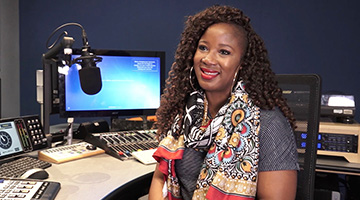
- Opportunities to broadcast via our Student Union’s award-winning radio station
- Opportunities for industry placements with media organisations: recent student experiences include reviewing Taylor Swift’s Anfield gig, reporting for Sky and the BBC during the General Election and creating multimedia promotional content for Eurovision in Liverpool
About your course
A highly practical programme, the BA (Hons) Journalism is taught using industry-standard facilities so you gain the hands-on experience you will need in your day-to-day work as a journalist.
From the first year onwards, you will learn to use our in-house facilities including edit suites, newsrooms and radio studios supported by specialist technicians and expert tutors.
Alongside hands-on training you will learn the basics of media law and how public bodies work, as well as considering the role of journalism in today’s world. We’ll also look at the challenges and opportunities AI brings to the industry. Digital journalism is embedded into our course and you will learn to write and produce content for online platforms, podcasts and social media.
You will also develop skills in analysis and interpretation, initiative and research, which are vital in any career, not just journalism. Whether you want to be a feature writer or photojournalist, in your third year you can specialise in an area related to your future career aspirations.
Our strong links with local news publishers, television companies and radio stations mean that there will be opportunities for invaluable work experience during the course, and you will be encouraged to get involved with various student media outlets in Liverpool, including our own website.
If you would like to see some of the work published by our students, take a look Mersey News Live and Mersey Sports Live.
You can also check out the student radio station, Moore Student Radio, which you can sign up to be part of during your time with us. Some of our student radio society members recently interviewed Miley Cyrus during Radio One Big Weekend in Liverpool.
Lucy Burns' experience as a Journalism student

Recent graduate, Lucy Burns explains what it's like to study on BA Journalism and BA Sports Journalism at LJMU.
Course modules
What you will study on this degree
This course is currently undergoing its scheduled programme review, which may impact the advertised modules. Programme review is a standard part of the University’s approach to quality assurance and enhancement, enabling us to ensure that our courses remain up to date and maintain their high standard and relevancy.
Once the review is completed, this course website page will be updated to reflect any approved changes to the advertised course. These approved changes will also be communicated to those who apply for the course to ensure they wish to proceed with their application.
Further guidance on modules
Modules are designated core or optional in accordance with professional body requirements, as applicable, and LJMU’s Academic Framework Regulations. Whilst you are required to study core modules, optional modules provide you with an element of choice. Their availability may vary and will be subject to meeting minimum student numbers.
Where changes to modules are necessary these will be communicated as appropriate.
Core modules
Introduction to Reporting
20 credits
20 credits
This module aims to develop your skills required to identify and source news stories, including finding contacts, effective interviewing and first-class research skills. You will be taught in seminars in which students will practice conducting different types of interviews and develop practical skills, using appropriate sources of information and identifying contacts. Seminars will also cover how to critically analyse good practice and journalistic processes.
Understanding Journalism
20 credits
20 credits
You will develop basic knowledge of key issues affecting the journalism industry including how it has evolved over time, looking at issues such as the changing economics of journalism and the influence of technology.
Reporting Skills
20 credits
20 credits
This module aims to hone sourcing, reporting and interview skills developed in semester one. You will apply these skills to the reporting of courts, councils and other such institutions, while developing an understanding of the importance of health and safety when working as a journalist.
Essential Law and Ethics
20 credits
20 credits
This module will prepare you for the NCTJ professional diploma examinations in Essential Media Law and Broadcast Regulation.
Introduction to Newswriting
20 credits
20 credits
This module introduces you to the fundamentals of writing news and the conventions of journalism practice.
Introduction to Broadcast
20 credits
20 credits
This module provides an introduction to broadcast. You will be taught current professional broadcast conventions and develop the basic technical skills necessary to produce material for radio and/or TV. You will learn how to write for broadcast and develop story treatments; you will become familiar with industry-standard software as you learn how to shoot and edit video and how to capture and edit audio.
Core modules
Journalism for a Digital Audience
20 credits
20 credits
This module gives you the opportunity to work as part of a news/sports news production team to create and update your own website. You'll learn how to craft web- and mobile-friendly headlines and write online stories designed to rank highly in search engine results (Search Engine Optimisation). You'll have hands-on experience of using an industry-standard content management system (CMS) such as WordPress, and use web analytics to tailor your content to your audience. The module will equip you to understand how user generated content (UGC) can be used to increase audience engagement, as well as provide additional content for your website. You'll take a critical look at the case for and against moderating user content, including issues of taste, decency and legality. Finally, you’ll use social media as a way to promote your website and as a source of fresh story ideas.
Developing Broadcast Skills
20 credits
20 credits
You will learn how to research, write and produce high-quality, professional standard reports for radio and/or TV. You will develop research skills in sourcing original stories and producing them ethically and accurately for broadcast. Students will become familiar with the technology, techniques, language and conventions of broadcast newsrooms; using electronic newsroom systems, recording audio, filming and editing to produce material in line with current professional broadcast practice. You will be expected to demonstrate developing skills in writing for broadcast including structure, introductions, understanding story treatments and writing to pictures. This module is designed to reflect the best current practice in broadcast newsrooms in the UK.
Reporting UK Politics
20 credits
20 credits
This module will prepare students for the NCTJ professional diploma examinations in Public Affairs for Journalists.
Multimedia News Production
20 credits
20 credits
You will develop and evaluate their journalistic and transferable skills to design and create multimedia products reflecting industry-standard journalistic practice. Newsdays will provide a real-time work-based learning environment for you to develop your understanding of professional requirements, deadlines, management and team working with the further acquisition and application of technical skills in the production of journalism artefacts. You will work in flexible, creative and independent ways, showing self-discipline, self-direction to communicate effectively in team settings, and in a variety of media, showing an understanding of target audiences and a developing news sense.
Journalism Issues
20 credits
20 credits
You will gain knowledge of key contemporary issues within the journalism industry and explore questions about the media's role in a modern, democratic society. This will include questions of diversity and inclusion such as changing attitudes towards the representation of different demographic groups and questions of inclusion within the media workforce. The module will include an examination of the international context of UK journalism and consideration of issues around decolonising journalism, for example questions of stereotyping in reporting of the developing world, and questions of universal news values. Students will develop an understanding of the ways in which the historical development of journalism continues to shape and influence the modern industry (for example through regulation, ownership, economic and technological factors).
Magazine Journalism
20 credits
20 credits
This module develops planning skills, page design skills, editing, interviewing and feature writing. The skills learned in this module will help prepare students for news days at level six, where interviewing, writing and editing will be required.
Optional modules
Study Year Abroad -Journalism
120 credits
120 credits
The aim is to provide students with an additional year of study at an approved overseas partner that will complement their programme at LJMU. This is an additional year of full-time study at an approved higher education institution. The modules to be studied must be agreed in advance, and must be appropriate for the student's programme of study. Assuming successful completion of this year, mark-bearing credit will be awarded by the University Recognition Group. The grade conversion scale to be used will be made available in advance of the year abroad.
Core modules
Journalism Careers
20 credits
20 credits
This module enables you to apply and evaluate your skills in a professional setting. It also provides you with the means to identify your skills and match them to the employment market. You are expected to provide evidence of a work placement.
Advanced Journalism Practice
40 credits
40 credits
You will develop and reflect on their journalistic and transferable skills to design and create multimedia products reflecting industry-standard practice. Newsdays will provide a real-time work-based learning environment for students to deepen your understanding of professional requirements, and the acquisition and application of technical skills in the production of journalism artefacts.
Optional modules
Features Journalism
20 credits
20 credits
You will develop a critical understanding of the purpose of features and associated forms of writing such as reviews and opinion.
You will construct and develop features/review ideas and write original material in a variety of specialist areas such as arts, lifestyle and culture. You will also analyse the impact of audience, market, available sources and other constraints on magazine production.
Dissertation
40 credits
40 credits
This module allows you to carry out a major project of private study and research. The dissertation is student led but supported by a series of lectures on methods and techniques followed by one-to-one supervision with a suitably qualified supervisor.
Sports Journalism
20 credits
20 credits
This module enables you to develop your understanding and practice of the reporting/function of sport in modern news-oriented media. You will also gain a greater understanding of sport as a cultural and economic entity, underpinning notions of joy and despair and providing a peaceful platform for the expression of civic and national pride. You will study through workshops and real-time learning simulations, as well as live match reporting exercises on location.
Final Project
40 credits
40 credits
The Journalism Final Project gives you an opportunity to design and create individual innovative journalism products for a defined audience. You will build on skills developed at Level 4 and 5 to identify a suitable topic and market for your project and to produce an artefact matching professional standards. Examples include a magazine, website, video or audio documentary or a portfolio of professional journalism produced as part of an extended work placement to be agreed by the project supervisor. You will also reflect on the production of the project and their personal skills development.
Photojournalism
20 credits
20 credits
This module is designed to equip a student journalist with the photography skills required to produce images of publishable quality that meet news industry standards. It is an option which aims to build on the essential skills learned in L4 and L5 with more advanced techniques in producing professional still news and sports images.
The way a photojournalist behaves is also central to their skills base. It is designed to equip candidates with an understanding of the legal and ethical issues which confront journalists in their day-to-day work when taking photographs. You will learn skills using more advanced photographic kit, producing imagery for digital and print platforms, various forms of photography including live action, photo-calls, location work, creative lighting, and multiple imagery for slideshows. And you will learn about the commercial importance of stills photography within industry and roles of freelance and staff photographers.
Public Interest Journalism
20 credits
20 credits
The court system; court reporting restrictions; contempt of court; anonymity rules in court reporting; defamation in court reporting; accessing court information; open justice; reporting inquests; a journalist rights in reporting councils, government and other public bodies; the application of the Freedom of Information Act.
Public Relations for Journalists
20 credits
20 credits
This module will prepare you for the NCTJ professional diploma examinations in Introduction to PR and Communications.
Professional accreditation
Accredited by the The National Council for the Training of Journalists and the Broadcast Journalism Training Council. Both industry accreditations means that the course focuses closely on UK employer requirements.
All LJMU journalism students will have the first attempt of their NCTJ assessments paid for by the university (subject to attendance).
BAFTA albert Education Partner
The Liverpool School of Art and Creative Industries is a BAFTA albert Education Partner and proud to be working with albert to arm students with the sustainability knowledge they’ll need when joining the screen industries. BAFTA albert is the leading screen industry organisation for environmental sustainability.
Your Learning Experience
Excellent facilities and learning resources
Teaching is delivered face-to-face via a combination of lectures, seminars and workshops, in addition to around 22 hours of weekly production work and independent research. This enables you to experience a rich and diverse learning experience and engage fully with your studies.
In your final year you will be expected to do more independent research on a topic of your choosing, and scheduled classes will reduce in order to give you time to focus on this major project.
Work-related Learning
This vocational course offers many opportunities for practical, hands-on experience and work placements, thanks to our connections in the local, national and international media. Recent LJMU Journalism student placements have included the BBC, Sky Sports, the Daily Mirror, the Liverpool Echo and Bauer Radio as well as leading PR companies. LJMU and Index on Censorship, a leading publication on free speech and human rights, offer a 12-month paid internship for a journalism student at the IOC headquarters in London. This is a great way to meet industry experts and learn about free speech around the world, as well as building skills in public relations, lobbying and campaigning.
You will be required to undertake 10 days of work experience at a media organisation of your choice. Work experience is an invaluable opportunity to practise your skills in a professional media environment and will put you at a distinct advantage over other applicants once you enter the competitive job market. In fact, many students are offered permanent jobs at institutions like the BBC, Reach Plc and Lime Pictures following a successful work placement.
Liverpool has a thriving journalism industry, with many multimedia publications based in the city.
Dedicated personal tutor, plus study skills support
When you study at LJMU, you will join a warm and friendly learning environment where creativity is nurtured and supported by excellent learning resources. Throughout your studies you will be supported by a dedicated personal tutor who will be available to discuss course-related issues, monitor your progress, and meet with you regularly to discuss your educational and career plans.
Assessment varies depending on the modules you choose, but will usually include a combination of exams and coursework.
We understand that all students perform differently depending on how they are assessed, which is why we use a range of assessment methods. These include: essays, projects, portfolios of work, exams, reports, group and individual presentations, and dissertations. Most of the work is journalism based, such as writing features and news stories, or creating magazines and digital content, and supported by academic essays and presentations.
Assessment will be mostly portfolio-based, with some exams in law, shorthand, media regulation and court reporting. Your final year Major Project/Dissertation will be 8,000 words or equivalent.
Where you will study
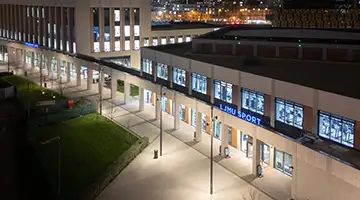
The Liverpool School of Art and Creative Industries is based in the Redmonds Building, in the heart of the bustling Mount Pleasant Campus and Liverpool's growing Knowledge Quarter. The building is home to high quality lecture theatres and seminar rooms, TV studios, radio suites, green screen, editing rooms and news rooms, social spaces, and a café. It is only a short walk from LJMUs Mount Pleasant Campus Library, which contains all the resources you will require for your studies, and is open seven days a week.
Course tutors

Fran runs the journalism department at LJMU and teaches at both undergraduate and postgraduate level across our courses. She holds a British Academy grant for her research into news literacy, on which she has worked with stakeholders including Ofcom, DCMS and the News Literacy Network. Before joining LJMU, she spent over a decade on national newspapers, most recently as Assistant Editor of i, where she oversaw the papers news output, as well as The Times and Independent.
This course will see you working as a trainee journalist in a realistic newsroom environment, taught by industry experts and gathering your own stories for our live websites, TV and radio bulletins. Our extensive links across journalism, including with newspapers, TV and multimedia platforms, create fantastic opportunities for work experience and help our industry-ready graduates go on to secure jobs across the sector.



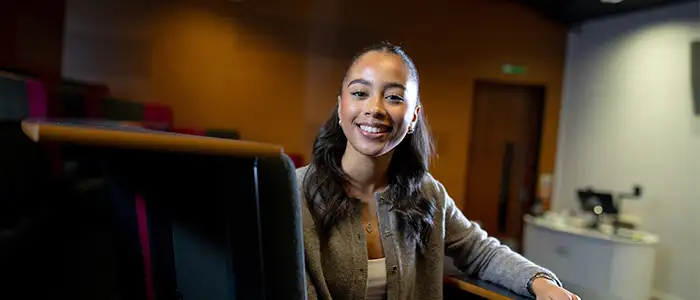
Academic staff are incredible and always on hand with easily accessible office hours and they’re only ever an email away. It has been nice building professional relationships with them, though on a personal level they are approachable well-humoured people. It really does make university life that much easier when you know you can ask for help.
Career paths
Once you graduate with a BA (Hons) Journalism degree, your practical skills in broadcasting, online and print journalism will qualify you to work in a variety of roles within this industry, from TV researchers to podcast producers
Our graduates have successful careers as reporters, writers, editors, specialist correspondents, freelance journalists and television presenters. As well as working in television and news publishing, they can be found in broadcasting and news agencies, public relations departments and consultancies, web-based media and local authority press departments.
Student Futures - Careers, Employability and Enterprise Service
A wide range of opportunities and support is available to you, within and beyond your course, to ensure our students experience a transformation in their career trajectory. Every undergraduate curriculum includes Future Focus during Level 4, an e-learning resource and workshop designed to help you to develop your talents, passion and purpose.
Every student has access to Careers Zone 24/7, LJMU's suite of online Apps, resources and jobs board via the LJMU Student Futures website.
Tuition fees and funding
- Full-time per year:
- £9,790
Fees
Tuition fees for home students beginning their studies in September 2026 will be £9,790 for the 2026/27 academic year, subject to Parliamentary approval.
In England and Wales, tuition fees for home undergraduate students are set in accordance with the Government’s regulated fee cap. The Government has confirmed that this cap will be £9,790 for 2026/27 and £10,050 for 2027/28, in both cases subject to Parliamentary approval.
The Government has also indicated that from the 2028/29 academic year onwards, the fee cap may be adjusted annually in line with inflation. As a result, tuition fees in future years may increase in line with inflation. We will provide confirmation of any changes as early as possible in advance of each academic year.
The university reserves the right to increase tuition fees in accordance with any changes to the maximum allowable fees set by the UK Parliament.
The fees quoted above cover registration, tuition, supervision, assessment and examinations as well as library membership and student IT support with access to printed, multimedia and digital resources including programme-appropriate software and on campus Wi-Fi.
Financial Support
The University offers a range of scholarships to support students through their studies. You'll find all the information you need on our specialist funding pages, including details of the Student Support Fund and other activities to support with the cost of living.
Additional Costs
In addition to fees, students should also keep in mind the cost of:
- Accommodation
- Travel costs including those for placements, visas and travel for studying abroad and field trips unless paid for by LJMU
- Stationery, IT equipment, professional body membership and graduation gown hire
- Full-time per year:
- £17,750
International Scholarships and payment plans
Liverpool John Moores University is committed to supporting international students by providing a range of scholarships and flexible payment plans to help students manage their tuition fees.
Scholarships
LJMU provides a variety of undergraduate scholarships to support international students. Scholarships are available to self-funded students who have accepted their offer and met all the conditions outlined in their offer letter. Students must also demonstrate that they can cover living costs, travel, and other expenses associated to studying at the university.
All self-funded international students are eligible for an automatic scholarship worth up to £3,000. For more details and to view our full list of scholarships, visit the international scholarship webpages.
Deposit
All students must pay a £5,000 deposit before they can receive their CAS letter.
For more information view our deposit page.
Tuition Fee Payment Plan
After paying their £5,000 deposit, students have the option to pay their fees in full or in three equal instalments minus any internal scholarships and discounts. There are two payment options available for international students. You can either pay your tuition fees in full before enrolment or opt for a payment plan. With the payment plan, you can pay your fees in three instalments after making your £5,000 deposit. The first instalment is due before enrolment.
All payments should be made through Flywire. Full details can be found in the How to Pay Guide.
Entry requirements
Please choose your qualifications below to view requirements
Grades/points required from qualifications: BBC (112)
Work out how many UCAS points your qualifications are worth by visiting the UCAS Tariff Calculator.
Qualification requirements
GCSEs and equivalents
A levels
BTECs
Extended Diploma: DMM
Access awards
International Baccalaureate
Acceptable on its own and combined with other qualifications
OCR Cambridge Technical
Extended Diploma: DMM
Irish awards
Acceptable on its own and combined with other qualifications
T levels
Further information
-
DBS, Occupational Health requirements
Can this course be deferred?
Yes
Is a DBS check required?
No
-
Contextual Offers
At LJMU, we are dedicated to widening participation in education. We understand that academic potential isn't always accurately represented by grades alone. Therefore, we consider additional information included in your application. If you meet certain eligibility criteria, we may make an offer lower than our typical entry requirements.
International requirements
IELTS
Further information
-
DBS, Occupational Health requirements
Can this course be deferred?
Yes
Is a DBS check required?
No
Please Note: All international qualifications are subject to a qualification equivalency check.
How to apply
Securing your place at LJMU
UCAS is the official application route for our full-time undergraduate courses. Further information on the UCAS application process can be found here https://www.ljmu.ac.uk/study/undergraduate-students/how-to-apply.
We are keen to recruit students who will make the best use of the opportunity to study with us. So we are looking for students with a flair for writing factual material. They need an enthusiasm for seeking out what's new, then asking why it is new, what's different, what's special, why it will interest the viewer, reader or listener - why, in short, it will be a good piece of journalism.
You should be able to demonstrate an interest in news and current affairs and, ideally, have a specialist area which you might like to develop such as music, sport or fashion, for instance. Enthusiasm for news and current affairs needs to be supported by general knowledge, an awareness of what's going on in the world and a burning desire to know more.
You should be interested in and sympathetic to people and their activities. You may well have studied a humanities and/or social science subject at school or college (e.g. English Language, English Literature, History, Politics, Sociology, Media Studies).
In particular, you will need to possess the following qualities:
Good communication skills, as you will be expected to contribute to tutorials and host presentations.
Time management, as you will have to work to deadlines on a regular basis - essential for a journalist.
Good IT skills, as you will be expected to submit work that has been word processed.
Good analytical skills, so that you can critically assess news sources.
Information retrieval techniques, as you will be expected to read around the subject and draw upon your findings for news and feature writing, essays, reports and projects.
Teamwork, as you may have to work closely with others which is essential in journalism.
You should ensure that your UCAS application shows that you meet the following essential criteria:
The ability to communicate ideas logically and in an easy-to-read, error-free style is vital and will be measured by your personal statement.
Evidence of an interest in news-orientated media, including activities such as student newspapers/magazines, hospital radio or work placements.
Evidence of an interest in the world around you: politics, science, history, finance, business, art, theatre, sports are among the areas for which we would expect you to have enthusiasm.
Evidence of additional skills or knowledge in one of these areas: knowledge of current affairs, a foreign language (GCSE level or above), knowledge of different countries and cultures, or relevant work experience.
It would also be helpful if you are able to show the following in your UCAS application:
An enthusiasm for IT and the new communication tools available on the internet and on mobile communication.
Evidence of personal development such as art, music, creative writing, sport, outdoor activities, D of E award scheme.
Involvement in social, community, political or charitable activities.
Your university life
From accommodation and academic support to clubs and societies. Find out what LJMU has to offer.
Related Links







Talk to our students
Connect with a current LJMU student for advice and guidance on university life, courses and more.
See what our students are saying
At LJMU we want you to know you're making the right choice by studying with us. You can see what our students are saying about their experience with us through their reviews on the following websites:


News and views
Browse through the latest news and stories from the university


The university reserves the right to withdraw or make alterations to a course and facilities if necessary; this may be because such changes are deemed to be beneficial to students, are minor in nature and unlikely to impact negatively upon students or become necessary due to circumstances beyond the control of the university. Where this does happen, the university operates a policy of consultation, advice and support to all enrolled students affected by the proposed change to their course or module.
Further information on the terms and conditions of any offer made, our admissions policy and the complaints and appeals process.