

MA Art in Science | Part-time
- Entry year:
- 2026/27
- Start date:
- September
- Study mode:
- Part-time
- Course duration:
- 2 years
- Campus:
- Mount Pleasant
Why study this course with LJMU?
The MA Art in Science programme brings artists and scientists together to work at the intersection of disciplines. It provides exciting opportunities for artists and scientists to collaborate across the visual arts and the world of scientific inquiry, and facilitates discussions and interactions between subjects that have traditionally been studied in isolation in Higher Education. This provides opportunities for innovation and critical creativity, and encourages students to produce art-science research that may have a real world benefit to society.
About this course
The MA Art in Science programme explores the rich and complex intersection of disciplines through meaningful collaboration between artists and scientists.
Art and science are often seen as two different entities with very separate ideas of what constitutes research. Increasingly, collaborations between artists and scientists are a feature of our cultural landscape. Traditionally this relationship has been perceived as art in the service of science, whereby artists use their skills to visually interpret or communicate complex scientific ideas, objects or forms. However, a hybrid form of research has emerged over the last 30 years where artists and scientists are interested in the creative possibilities and speculative futures of the intersection of these two cultures.
The MA Art in Science programme is an exciting opportunity for artists and scientists to explore the boundaries of art and science, and encourages students to consider, adopt and implement a range of interdisciplinary, multidisciplinary or transdisciplinary methods, to refine, extend, develop and critically reflect upon their own practice, enhancing the skills that they bring with them to the programme and those that they develop during their studies.
- Enrol on an innovative programme, collaboratively developed with academic experts across a number of disciplines that include: Art and Design, Sports Science, Microbiology, Forensics, Public Health, Astrophysics, and Botany
- Explore the relationship between art and science, including the historical and theoretical connections between art and science as cultures and practices, and understand how these ideas translate into contemporary experiences
- Develop real world skills and decide which areas of art and science you wish to investigate as you progress through the programme
- Design and deliver art-science practice-based or practice-led research projects in unexpected forms
- Enjoy access to a number of different established art and science research centres across Liverpool John Moores University
- Apply for postgraduate Susan Cotton travel funding to expand your research and cultural experience.
- This programme is also available in full-time study mode
The programme fosters an inquisitive approach whereby the focus is on encounters with new practical skills and ideas to develop the student's art-science praxis. By acknowledging the specific relationships within, between, beyond or across conventional disciplines, and by working as individuals or in groups, or establishing new relationships and collaborations, students will produce innovative, visionary and speculative practical outcomes in the context of one or more disciplinary contexts. Outcomes will be creatively driven and evidence critical reflection.
Learning takes place predominantly through workshops lectures, seminars, reading groups and studio crits. You will study themes related to art-science interactions; studio/lab practice at the boundaries of disciplines; visualising the unseen and objectivity/subjectivity; ethics of display of human remains; anatomical and medical art; arts in health and graphic medicine; bioart, biohacking and bioethics; transhumanism and digital bodies; working with humans in research, and art-science public engagement.
Alongside your fellow Art in Science students there will also be several opportunities to collaborate with students and staff from the MAs in Cities, Exhibition Studies, Fashion Innovation, Fine Art, Illustration, and Immersive Media, particularly during two modules shared by all the postgraduate taught programmes.
You will be able to access a number of different research centres and cultural institutions across Liverpool to support your learning experience, including the World Museum Liverpool, Liverpool Medical Institution, Astrophysics Research Institute, Research Institute for Sports and Exercise Sciences, Public Health Institute, Forensic Research Institute, and Institute of Art and Technology.
Guest lecturers working across art-science disciplines will expose students to critically engaged making and design practices, and learning from and interacting with globally renowned practitioners and researchers; students will receive a rich and diverse introduction to a range of international collaborative practices that are at the root of cutting edge art-science collaborative research.
Collaborative opportunities enable you to specialise throughout the programme and, on graduation, you will leave with a portfolio of practical skills in areas such as visual interpretation and presentation of complex scientific ideas. You will develop an understanding of the research skills required to be employed as an artist in a scientific field, including an understanding of ethics and public engagement. As a graduate you will be able to apply critical and practical skills, research techniques and understanding of art-science praxis in your chosen career.
Natasha talks about her experience on the MA

Jay Hampton (MA Art in Science graduate)
“The programme opens the doors people don’t usually get opened, meaning you can come from any background and as long as you have an interest in science that you want to explore though creative practice, then the programme is perfect for you."
Mark Roughley: Programme Leader, Art in Science

"I enjoy collaborating across disciplines and there is a buzz about artists and scientists working together in innovative ways. With exciting collaborative research happening in research centres across LJMU, I am excited to bring together interested individuals to explore and cultivate the growing art-science community in Liverpool and the UK."
Course modules
Discover the building blocks of your programme
The Art in Science programme comprises five modules: four taught modules studied between September and April (two modules per semester) and one research project module undertaken between May and August.
To foster a collaborative research culture, students from all taught postgraduate programmes in the school study two modules together: 'Research Inquiry' and 'Transdisciplinary Practice'.
Further guidance on modules
Modules are designated core or optional in accordance with professional body requirements, as applicable, and LJMU’s Academic Framework Regulations. Whilst you are required to study core modules, optional modules provide you with an element of choice. Their availability may vary and will be subject to meeting minimum student numbers.
Where changes to modules are necessary these will be communicated as appropriate.
Core modules
Studio Practice - Art in Science
30 credits
30 credits
This module concerns the development of your individual art-science practice. The module’s structure fosters an inquisitive approach whereby the focus is on introductory gestures with new practical skills and ideas in contemporary art-science to enable you to produce work that replicates and simulates real world interactions for making, research and collaborative practice.
The module equips you with a baseline of historical and theoretical underpinnings of art-science and an understanding of how to apply ideas that challenge existing knowledge. You will study themes related to art-science interactions; studio/lab practice at the boundaries of disciplines; visualising the unseen and objectivity/subjectivity; anatomical and medical art; scientific illustration and bioart. This ensures that you have the resources to engage with current debates and issues within art-science research and practice, and enables you to establish a deep and inquisitive relationship with critical theories and practices within experimental art-science interactions, the contexts within which they are deployed and the research against which they are evaluated.
Your practical work will explore art-science concepts and challenge preconceived notions of art and science practice. You will learn from practitioners and researchers across art and science disciplines, including those based in the Astrophysics Research Institute, the Research Institute for Sports and Exercise Sciences, the Public Health Institute, and the Forensic Research Institute.
Learning on the module combines experiential elements in studios and laboratories with more formal lecture and seminar-based delivery, and you will be introduced to specialist workshops and technical support to develop your practical skills and support your on-going project work. Assessments will include the presentation of development work and outcomes in a portfolio, accompanied by a verbal presentation.
Major Project - Art in Science
60 credits
60 credits
In this module you will explore the creative possibilities and speculative futures at the intersection of Art and Science through the production of a research proposal and development of a practice-based or practice-led research project appropriate to your art-science research concerns, which is supported by critical reflection and evaluation.
The module provides an opportunity for innovation and critical creativity and encourages you to produce inter-multi-transdisciplinary work that may have a real world benefit to society. You will have the opportunity to produce a self-directed and substantial body of work that is closely linked with your personal career aspirations. The kind of work expected should demonstrate a high level of conceptual thought and understanding of the historical and theoretical connections between art and science as cultures and practices, and show how these ideas translate into contemporary experiences.
Students will be required to make a working proposal for which they will receive feedback and guidance towards its realisation. Lectures and seminars will support learning, and tutorials and practical activities will develop the project towards outcome(s). This will enable you to plan, organise and present a final art-science research project through effective time and resource management, high level of critical engagement, creative achievement and appropriate technical ability. Collaboration is recommended throughout this module. You will develop your ability to speak publicly about your work and enhance your capacity to engage in professional practice.
Students will be assessed by a public-facing outcome of a significant body of work, supporting by documentation of supporting work, and both written and verbal critical reflection and evaluation.
Transdisciplinary Practice
30 credits
30 credits
This module is shared by all students studying on taught Art and Design postgraduate programmes.
The Transdisciplinary Practice module concerns the development of your individual practice. It sees you consider, adopt and implement a range of interdisciplinary, multidisciplinary or transdisciplinary methods, to refine, extend, develop and critically reflect upon your own practice. This enables a deeper relationship to one's own practice by seeing it through the lens of other disciplines, and cultivates more sympathetic understanding of the contingencies of other practices and disciplines through the same process.
You will work as individuals or in groups, or establish new relationships and collaborations to produce innovative, visionary and speculative practical outcomes in the context of one or more disciplinary contexts.
The module enables you to propose, plan, organise, publish or promote your work and research. Outcomes could include proposals for applied creative projects, documentary of work in progress, exhibition of work(s), public presentations in symposiums, websites or printed publications.
Learning is predominantly through lectures, reading groups and seminars. You will be introduced to ongoing inter-multi-transdisciplinary projects in the Institute of Art and Technology (IAT) and in the Liverpool City region through guest speakers who will expose you to new ways of working.
Peer review is a crucial part of the practice-based research experience and this is facilitated through student-led and tutor guided studio activities and critical reviews. At this level it is expected that you will show a high degree of motivation and ability to engage in self-directed study, demonstrating a level of scholarship, initiative and problem solving appropriate to Master's degree study.
Critical Discourses - Art in Science
30 credits
30 credits
This module places emphasis on engagement with current debates and issues within contemporary art practice and its relationship with science, through analysis of the concepts, values and debates that inform study and practice in the field. This includes being aware of matters relating to ethics of display of human remains; arts in health and graphic medicine; bioart, biohacking and bioethics; transhumanism and digital bodies, and public engagement with science in unexpected locations such as festivals. The module is supported by guest lecturers who will expose you to a range of critical discourses in art-science.
The module supports you in building upon the written, research and critical skills acquired in other areas of the programme, and develops skills to be able to present ideas to specialist or non-specialist audiences. You will produce illustrated and designed written projects relating to your specific art-science research interests and relevant to a specific area of art-science. These include public-facing online publications and academic essays. The subject matter will emerge through discussions over the course of your studies and you will critically explore the ethical, theoretical, socio-political and professional contexts of art and science.
Learning on the module is supported by lectures and seminars, and tutorials and writing workshops.
Research Inquiry
30 credits
30 credits
This module is shared by all students studying on taught Art and Design, MA Cities and Immersive Media postgraduate programmes.
The Research Inquiry module aims to develop and improve your research and analytical skills. Analysis and problem-solving skills are critical to student employability and subsequent success in most types of careers post MA.
Students are immersed in a range of methodological approaches across the arts and social sciences, and will develop an in-depth understanding and knowledge of contemporary approaches to research in their field of study. This will be crucial in laying the foundation for developing their own subsequent projects.
A series of lectures and seminars will introduce you to current and emerging practice in relation to a diverse range of historical, theoretical and critical principles. Seminars will require you to share, discuss and evaluate ideas and practice with others.
You will read and discuss a range of primary and secondary texts in your chosen field(s) to develop critical thinking together with historical and theoretical knowledge.
The module culminates in the successful preparation and delivery of a professional project proposal and accompanying professional presentation.
Your Learning Experience
An insight into teaching on your course
Teaching methods
The programme aims to provide a balance of opportunities for students to acquire and develop advanced practical skills, academic knowledge and transferable skills.
As a student-centred programme you will establish a deep and inquisitive relationship with art-science critical theories and practices, the contexts within which they are deployed and the research against which they are evaluated to be able to develop your own art-science practice.
Learning on the programme combines experiential elements in studios and laboratories with more formal lecture and seminar based delivery supported by reading groups. You will be introduced to specialist workshops and technical support and develop their practical skills and support on-going project work.
The programme is supported by guest lecturers from a range of science disciplines including botany, microbiology, forensics, astrophysics, mathematics, public health, and medical simulation who will expose you to a range of critical discourses in art-science.
Peer review is a crucial part of the practice-based research experience and this is facilitated through student-led and tutor guided studio activities and critical reviews. At this level it is expected that students will show a high degree of motivation and ability to engage in self-directed study, demonstrating a level of scholarship, initiative and problem solving appropriate to Master's degree study.
Study hours
Teaching across each semester is intensive and varies depending on the modules being studied. The two main teaching contact days are Mondays and Tuesdays. You are expected to develop your practice and projects in your non-contact study days.
Applied learning
As a student on this programme you will be introduced to the Institute of Art and Technology (IAT). The IAT is a world-leading centre for artistic, technological and transdisciplinary research and hosts inquisitive and creative researchers from around the world: all teaching, all learning, all working together for a better future. As Liverpool's international flagship for cultural and creative research, the IAT is a collective network of artistic research and technologies laboratories, each with a team led by inspiring researchers.
The MA Art in Science programme operates Liverpool LASER talks across Liverpool City region. Liverpool LASER is part of the worldwide series of Leonardo Art Science Evening Rendezvous (LASER) Talks sponsored by Leonardo, the International Society for Art, Sciences and Technology (Leonardo/ISAST). LASER talks are an international programme of free evening gatherings that bring artists and scientists together for informal presentations and conversations on art, science and technology.
Keep up to date on programme activities by following us on Bluesky, Facebook and Instagram @ArtinScienceMA
Explore past student research projects via the School of Art and Creative Industries degree show.
How learning is monitored on your programme
To cater for the wide-ranging content of our courses and the varied learning preferences of our students, we offer a range of assessment methods on each programme.
The programme is assessed through presentations, proposals, portfolios of practical project outcomes and artefacts, exhibitions, reports and supporting development work. The high level of seminar and tutorial contact allows for considerable formative assessment and feedback ahead of the summative assessment for each module.
Where you will study
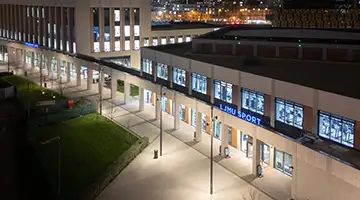
This programme is based in the John Lennon Art and Design building, a purpose-built facility in the Mount Pleasant Campus which encourages interaction between different disciplines and the sharing of ideas and expertise. The building houses state-of-the-art facilities and workshops.
Students are inducted into the school's specialist workshops including a digital imaging suite, print studio, and cutting-edge Fab Lab where they are encouraged to play, create, learn, and invent. Students also have opportunities to be introduced to science facilities at LJMU, including microscopy laboratories, endoscopy simulation suites and botany greenhouses at our Tithebarn health campus and Byrom Street science campus.
You have full use of several libraries within the city, and a Student Life Building with 24hr access.
During your studies you will also be introduced to our school's research institute, the Institute of Art and Technology (IAT), which comprises four research labs: including: Contemporary Art Lab, Exhibition Research Lab, City Lab, and the XLab – extending student access to a range of world leading researchers.
Course tutors

Mark is a Reader in Interdisciplinary Digital Visualisation and a member of the Face Lab research group that explores faces and art-science applications. Mark trained as a medical artist, gaining his MSc in Medical Art from the University of Dundee. He specialises in visualising anatomy through 3D data acquisition, modelling and fabrication. Marks research focuses on the affordances that 3D digital technologies allow for both digital and haptic interaction with anatomy and cultural artefacts. Mark is also the host of Liverpool LASER Talks. LASER (Leonardo Art Science Evening Rendezvous) is an international programme of evening gatherings that bring artists and scientists together for informal presentations and conversations on art, science and technology.


Studying art in science was one of the best decisions I ever made! I was surprised to see how much the knowledge gained from sessions on bioethics and bioart informs my current job as a medical writer, and as a practising by artist exhibiting internationally at venues including science gallery Melbourne and art Science Museum Singapore.
Career paths
Further your career prospects
LJMU has an excellent employability record with 97% of our postgraduates in work or further study fifteen months after graduation (Graduate Outcomes Survey, 2025). Our applied learning techniques and strong industry connections ensure our students are fully prepared for the workplace on graduation and understand how to apply their knowledge in a real world context.
Our aim is for students to complete the programme in readiness for self-employment or the world of work within their chosen specialist field. On graduation this MA may be used for a range of purposes within public health, biomedical communications, scientific illustration, public engagement with science, and STEAM education.
Many graduates may go on to work freelance, however there are also career opportunities in a range of related sectors. Graduates have gone on to secure Artist Residencies with METAL (Liverpool), Independents Biennial (Liverpool) and Open Eye Gallery (Liverpool), and exhibit work nationally at venues such as Plas Bodfa (Wales), or internationally, including at the Science Gallery Melbourne (Australia). Some have worked with national and international museums to engage the public with science in a range of contexts. Additionally, graduates have worked as Medical Writers for the National Institutes of Health (USA), and as Production Coordinators for the Science Museum Group (National Science and Media Museum, Bradford).
Others have gone on to work as Research Assistants for research institutions with roles that include scientific illustration, public health communications, and public engagement with science through comics and games (Liverpool School of Tropical Medicine, and University of Liverpool). Some have trained as School Teachers or educational technologists, and others have gone on to complete Doctoral Research.
Tuition fees and funding
- Part-time per credit:
- £60
Fees
The fees quoted above cover registration, tuition, supervision, assessment and examinations as well as library membership and student IT support with access to printed, multimedia and digital resources including programme-appropriate software and on campus wifi.
Financial Support
There are many ways to fund postgraduate study for home and international students. From loans to International Scholarships and subject-specific funding, you’ll find all of the information you need on our specialist postgraduate funding pages. The University offers a range of financial support for students. You'll find all the information you need on our specialist financial support pages including details of the Student Support Fund and other activities to support with the cost of living.
Additional Costs
In addition to fees, students should also keep in mind the cost of:
- Accommodation
- Travel costs and field trips unless paid for by LJMU
- Stationery, IT equipment, professional body membership and graduation gown hire
Entry requirements
You will need:
Qualification requirements
Undergraduate degree
- Minimum 2:1 honours degree in a related subject area.
- Those with a 2:2, non-related degree or non-standard background will be considered on an individual basis and will need to attend an interview and provide a portfolio (plus a CV for non-standard applicants).
Further information
-
Extra Requirements
-
You are required to submit a portfolio of 8-12 images or videos (of any subject in any media) or written work (such as essays, dissertations or blog posts), that demonstrate your own practice and/or interest in art-science.
-
Please note we are unable to consider your application until the Portfolio is received.
-
It is recommended to submit your Portfolio as either a PDF, PowerPoint or link to an Online Portfolio (website, video hosting platform etc.) to enable us to consider your application. Please make sure you include captions to give a brief description of your images/projects. If you do not provide a portfolio at the point of application you will be contacted to submit this to our upload attachment facility.
-
You will also need to supply a Personal Statement outlining your practice and your interests in art-science (who and what interests you), plus an academic reference.
-
-
RPL
- RPL is accepted on this programme
International requirements
IELTS
- IELTS English language requirement: 6.5 (minimum 5.5 in each component).
Further information
-
Extra Requirements
-
You are required to submit a portfolio of 8-12 images or videos (of any subject in any media) or written work (such as essays, dissertations or blog posts), that demonstrate your own practice and/or interest in art-science.
-
Please note we are unable to consider your application until the Portfolio is received.
-
It is recommended to submit your Portfolio as either a PDF, PowerPoint or link to an Online Portfolio (website, video hosting platform etc.) to enable us to consider your application. Please make sure you include captions to give a brief description of your images/projects. If you do not provide a portfolio at the point of application you will be contacted to submit this to our upload attachment facility.
-
You will also need to supply a Personal Statement outlining your practice and your interests in art-science (who and what interests you), plus an academic reference.
-
-
RPL
- RPL is accepted on this programme
Please Note: All international qualifications are subject to a qualification equivalency check.
How to apply
Securing your place at LJMU
To apply for this programme, you are required to complete an LJMU online application form. You will need to provide details of previous qualifications and a personal statement outlining why you wish to study this programme.
All applicants should be able to demonstrate a sufficient level of knowledge to embark on the programme (including the linguistic competence) and to complete the programme within time limits. You will also be required to submit a Portfolio, Personal Statement and Academic References to support your application.
- You are required to submit a portfolio of 8-12 images or videos (of any subject in any media) or written work (such as essays, dissertations or blog posts), that demonstrate your own practice and/or interest in art-science. Please note we are unable to consider your application until the Portfolio is received.
- It is recommended to submit your Portfolio as either a PDF, PowerPoint or link to an Online Portfolio (website, video hosting platform etc.) to enable us to consider your application. Please make sure you include captions to give a brief description of your images/projects. If you do not provide a portfolio at the point of application, you will be contacted to submit this to our upload attachment facility.
- Your personal statement should detail why you wish to study this programme and include personal experience and particular aspects of the programme that you find interesting. It should outline your practice and your interests in art-science (who and what interests you).
We recommend applications are submitted by July to allow sufficient time for these to be considered and necessary information and arrangements completed before the programme commences. However, applications will be considered up until the end of August.
Your university life
From accommodation and academic support to clubs and societies. Find out what LJMU has to offer.
Related Links


Talk to our students
Connect with a current LJMU student for advice and guidance on university life, courses and more.
See what our students are saying
At LJMU we want you to know you’re making the right choice by studying with us. You can see what our students are saying about their experience with us through their reviews on the following websites:


News and views
Browse through the latest news and stories from the university
The University reserves the right to withdraw or make alterations to a course and facilities if necessary; this may be because such changes are deemed to be beneficial to students, are minor in nature and unlikely to impact negatively upon students or become necessary due to circumstances beyond the control of the University. Where this does happen, the University operates a policy of consultation, advice and support to all enrolled students affected by the proposed change to their course or module.